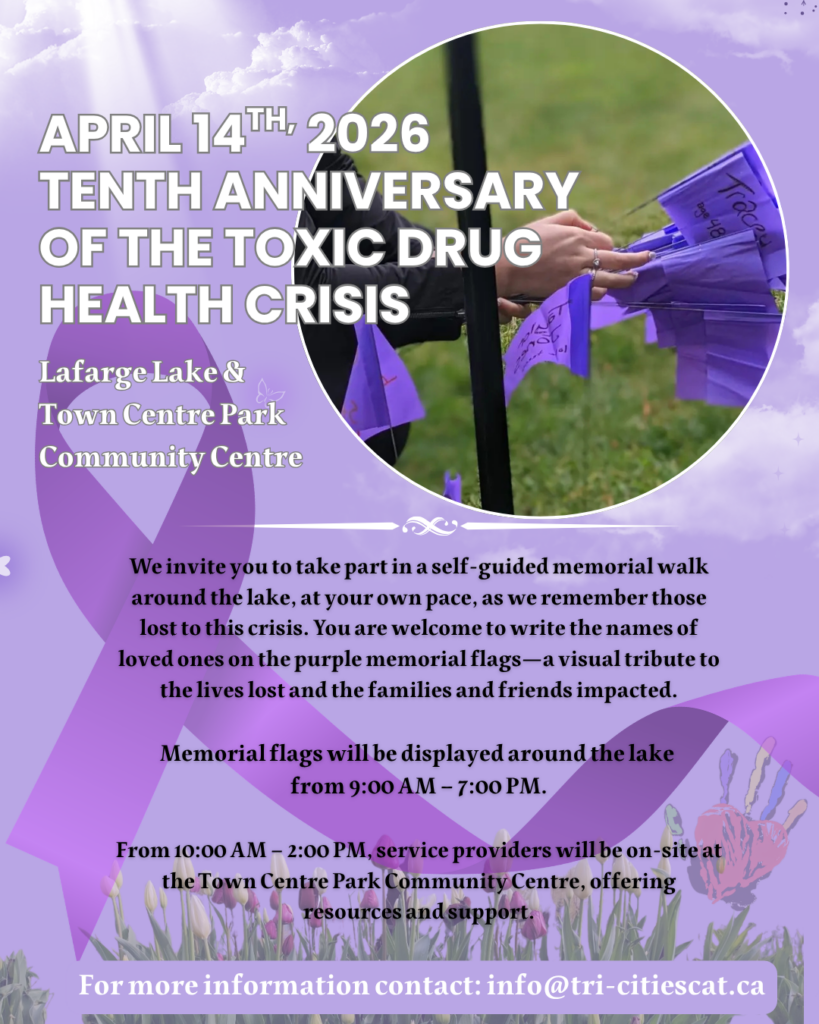
As we gather at Town Centre Park for our annual memorial walk, we mark a heavy milestone: April 14, 2026, is the 10th anniversary of the public health emergency. For a decade, we have planted purple flags—each one a life, a story, and a preventable tragedy.
The Numbers: A Decade of Loss (2016–2026)
To understand the crisis in the Tri-Cities, we must look at the provincial context. Since the emergency was declared in 2016:
- Provincial (B.C.): We have lost over 18,300 British Columbians. That is more than the deaths from homicides, car accidents, and fires combined in that same decade. (Source: BC Coroners Service, March 2026).
- The Daily Toll: While we saw a 10% decrease in early 2026 compared to the previous year, we are still losing nearly five people every single day. (Source: BC Coroners Monthly Report, Feb 2026).
- Regional (Fraser Health): Our region consistently remains the most impacted, with 533 deaths in 2025 alone. (Source: Fraser Health Toxic Drug Response Report, 2025).
The Tri-Cities: Resilience is Not the Same as Safety
In the Tri-Cities, we see a unique phenomenon in the data—what we call the “Gap of Resilience.” Since 2016, our community has consistently shown a high volume of emergency calls compared to fatalities.
| Year | Tri-Cities Paramedic Calls (BCEHS) | Tri-Cities Deaths (BC Coroners) |
|---|---|---|
| 2016 | 415 | 28 |
| 2021 | 682 | 44 |
| 2025 | 647* | 32* |
Export to Sheets
*Preliminary estimates based on 2025/26 monthly situational reports.
What is the “Gap of Resilience”?
This concept is championed by peer advocates, the Tri-Cities Community Action Team (TC CAT), and researchers from the BC Centre for Disease Control (BCCDC). It represents the statistical space between 9-1-1 calls and actual deaths.
- High Calls + Lower Deaths = High Resilience: In the Tri-Cities, paramedic calls have risen steadily since 2016, but the death rate has remained relatively flat in comparison.
- The “Invisible” Save: Every time someone calls 9-1-1, administers Naloxone, or performs rescue breathing, they are closing that gap. These are thousands of “saves” that don’t make the headlines but represent a community fighting for every single life.
However, we must be clear: While our death rate is lower than in neighbouring cities, it is not “good.” The low numbers aren’t a sign that the crisis is over; they are a sign that our community is working overtime to keep people alive in a system that is still broken.
The “Naloxone Gap”: Why Education is Changing
The drug supply is becoming more complex. We are seeing a rise in medetomidine, a synthetic tranquilizer 200x stronger than xylazine. In 2026, it is appearing in over 50% of samples in our region. (Source: BCCSU Drug Checking Alert, Jan 2026).
Crucial Education: Medetomidine is a sedative. Naloxone will NOT wake someone up from a sedative nod.
- Don’t “Stack” Naloxone: If you give a dose and they are breathing (at least 1 breath every 5 seconds), stop. More Naloxone won’t help the sedation and can cause violent withdrawal.
- Focus on Air: If they aren’t breathing, give naloxone and start rescue breathing. Oxygen is what prevents brain damage.
We Can Do Better: Wrap-Around Care
A decade into this emergency, we know that paramedics and Naloxone are “ambulances at the bottom of the cliff” solutions. We need a wrap-around model locally:
- Local RAAC: We need a rapid access to an addiction care clinic here. Our residents shouldn’t have to leave the Tri-Cities to obtain medical stabilization.
- Housing & Mental Health: You cannot recover in a crisis. We need lower-income housing and integrated supports that treat the person, not just the substance.
Actions You Can Take Today
- Check in on your loved ones: Break the isolation that leads to using alone.
- Get Educated: Learn how to handle “complex” overdoses involving sedatives.
- Create Awareness: Talk to your neighbours. Every conversation helps peel back the layers of stigma.
- Advocate Locally: Support the call for local Tri-Cities wrap-around services.
We invite you to join us at Lafarge Lake to walk, remember, and reignite our commitment to a future where every member of the Tri-Cities is safe.
Resources for Support
- Lifeguard App: (Automatic 9-1-1 Alert)
- NORS: 1-888-688-6677 (Confidential witnessing)
- Opioid Treatment Access Line: 1-833-804-8111
- Fraser Health OOT: 236-332-4857 (Mobile navigation support)
- Moms Stop The Harm: 1-866-355-MSTH (Grief and family support)
Official Sources
- BC Coroners Service: Unregulated Drug Toxicity Deaths Report (March 12, 2026).
- BCEHS: Overdose and Drug Poisoning Data Dashboard (2016–2026).
- Fraser Health: Toxic Drug Response Public Reports (2021–2025).
- BCCSU: Clinical Bulletin on Medetomidine Adulterants (February 2026).
- CTV/CBC: “Decade of Death: B.C.’s 10-year overdose health emergency” (April 2026).